Itinerary for "World Cultural Heritage of Korea"
Important! The itinerary below is a PRELIMINARY one. Korea Konsult reserves the right to change some parts of the itinerary below if needed. Eventual itinerary changes after the group arrival in the South Korea are beyond our control. Under no circumstances can Korea Konsult be held responsible for any itinerary changes.
|
|
 |
"World Cultural Heritage" is an perfect independent tour to South Korea if you want to familiriaze yourself with Korea and experience sights enlisted in UNESCO World Cultural Heritage List. Among many other things you will visit Seoul, stay in a Buddhist temple and experience the ancient capital Gyeongju.
Gyeongju was the capital of the ancient kingdom of Silla (57 BC – 935 AD) which ruled about two-thirds of the Korean Peninsula between the 7th and 9th centuries. A vast number of archaeological sites and cultural properties from this period remain in the city. Gyeongju is often referred to as "the museum without walls" |
|
|
The tour price covers: |
The tour price doesn't cover: |
- 5 nights at 3*/4* hotel (breakfast included), 1 night in a monastery (breakfast and dinner included)
- Indicated in program meals at local restraunts
- Transportation
- English speaking guide
- Entry tickets
|
- Tickets to/from Seoul
- Insurance
- Extra charge for French/German/Spanish speaking guide (50 Euro per group)
|
Day 1 : Arrival-Seoul
Included meals: no
- Meet our driver and transfer
(Van and driver only without guide’s assistance)to Seoul. As the nation’s capital with over 500 years of history, Seoul serves as the political, economic and educational hub of Korea
- Hotel check in and rest
Day 2 : Seoul
Included meals: breakfast, lunch, dinner
- Breakfast in the hotel
- transfer to Suwon -the provincial capital and largest city in Gyeonggi-do and has a population of just over one million. It is about 30 km from Seoul.
- Visit Hwaseong Fortress[UNESCO Heritage] designed to serve political and commercial as well as military functions and is a fine example of oriental fortresses. Hwaseong Fortress is an impressive structure from the latter part of the Joseon Dynasty (1392-1910). The fortress (constructed from 1794 to 1796) was built as a show of the King’s filial piety towards his father Jangheonseja and to build a new pioneer city with its own economic power
The fortress wall stretches for a total of 5.52km and has a great variety of military facilities that’s hard to find anywhere else
- Experience of traditional archery
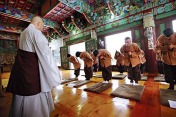
- Return to Seoul and transfer to Geumseonsa temple for a temple stay program. The temple is located in Bukhansan, officially designated a national park, which is the highest mountain in the Seoul area. Beloved not only for its unique urban location, the mountain is also treasured for its natural beauty and cultural assets. Also known as Samgaksan (meaning “Triangle Mountain”), Bukhansan has three major peaks: Baegundae (the main peak), Insubong to the north, and Mangyeongdae to the south
- Temple Stay Program:
- Orientation
- Temple Tour with a monk
- Dinner (Gong yang)
- Striking the bell
- Ye-bool (evening chanting ceremony)
- 108 prostrations
- Meditation
- Shower and bed time
Day 3 : Seoul
Included meals: breakfast, lunch
- Continue the morning temple stay program
- wake up
- Ye-bool (morning chanting ceremony)
- Meditation
- Baru-gongyang (formal monastic meal)
- Conversation with a monk
- Trekking Mt.Bukhan
- Lunch & writing postscript
- Closing ceremony
- Visit Changdeokgung Palace which is enlisted to World Cultural Heritage List by UNESCO. Changdeokgung Palace was the second royal villa built following the construction of Gyeongbukgung Palace in 1405. It was the principal palace for many of the Joseon kings and is the most well-preserved of the five remaining royal Joseon palaces. The palace grounds are comprised of a public palace area, a royal family residence building, and the rear garden. Known as a place of rest for the kings, the rear garden boasts a gigantic tree that is over 300 years old, a small pond, and a pavilion
- Visit famous for its beauty Huwon garden - secret Garden[UNESCO Heritage]
- Stroll down Insadong Antique alley; the center of Korea’s traditional art and antique,
- Enjoy Namdaemun Market, the largest conventional market in the country, which boasts various merchandise including clothing, leather goods, shoes, accessories and gift items, etc.
- After your own dinner, climb to Seoul Tower to enjoy panoramic view of nigh Seoul
- Back to he hotel
Day 4 : Seoul/Andong/Daegu
Included meals: breakfast, lunch
- Breakfast in the hotel
- Transfer to Andong - the self-proclaimed "Capital City of Korean Spiritual Culture", having maintained aspects of the traditional culture of Korea throughout the past 2,000 years. Over 280 cultural assets are scattered around the city.
- visit Hahoe Village[UNESCO Heritage] which preserves architecture, folk traditions, and valuable books, and old tradition of clan-based villagesfrom the Joseon Dynasty and designated as World Cultural Heritage
- Experience ancient Korean culture: learn how to draw the orchid on Hanji- traditional paper
- Transfer to Daegu - the fourth largest after Seoul, Busan, and Incheon, and the third largest metropolitan area in the nation with over 2.5 million residents
- Hotel check in (in Daegu)
Day 5 : Daegu/Hapcheon/Gyeongju
Included meals: breakfast , lunch
- Breakfast in the hotel
- Transfer to Haeinsa Temple[UNESCO Heritage] which is most notable for being the home of the Tripitaka Koreana, the whole of the Buddhist Scriptures carved onto 81,350 wooden printing blocks, which it has housed since 1398.
- Leave for Gyeongju which was served as the capital of Silla Kingdom(57BC-935AD). The entire city of Gyeongju is a living history museum containing the remnants of the Silla Kingdom as well as relics pertaining to Buddhism, the national religion at the time.
- Visit Daereungwon Tumuli Park; a collection of royal Silla tombs, and Anapji Pond in the evening where the Silla royal family relaxed and enjoyed themselves.
- Hotel check in (in Gyeongju)
Day 6 : Gyeongju/Seoul
Included meals: breakfast , lunch
- Breakfast in the hotel
- Visit two magnificent temples both of which are enlisted to World Cultural Heritage List by UNESCO
- Seokguram Grotto; one of Asia’s finest Buddhist shrines surrounded by Bodhisattva, disciples, devas and guardian king;
- Bulguksa Temple, an architectural masterpiece built during the glorious period of Silla Kingdom.
- Return to Seoul
- Hotel check in (in Seoul)
Day 7 : Seoul/Departure
Included meals: breakfast
- Breakfast in the hotel
- Hotel check out and transfer to the airport
The materials from wikipedia.org and visitkorea.or.kr were used at this page |


